

Moving From Seattle to Vancouver, WA, in Retirement: What to Consider Before You Move
Moving From Seattle to Vancouver, WA, in Retirement: What to Consider Before You Move

Perhaps your Seattle home feels larger than you need. Your grandchildren live in Southwest Washington. Or you are wondering whether the equity you have built could help support a different retirement lifestyle.
Moving from Seattle to Vancouver, Washington, can offer a fresh start while keeping you in the Pacific Northwest. Before putting your home on the market, however, consider how the move could affect your housing expenses, retirement income, healthcare and relationships.
Would relocating bring you closer to the life you want, at a cost your retirement plan can support?
Vancouver continues to grow
According to Washington’s Office of Financial Management, Vancouver ranked fourth among Washington cities for numeric population growth between April 2025 and April 2026. Statewide, Washington added an estimated 61,200 residents, with net migration accounting for 43,870 people, or approximately 72% of that increase.¹
Net migration measures people moving in minus those moving out. These statewide figures include domestic and international migration; they do not establish how many Seattle residents relocated to Vancouver or how many newcomers were retirees.
For someone considering the move, these figures provide context for a growing community. The personal decision requires a closer look at your own finances and priorities.
Picture your everyday life before choosing a home
Before comparing properties, consider what you hope the move will accomplish.
You may want to live closer to family, spend less time maintaining a house or preserve more money for travel. Perhaps you want a home that will be easier to navigate as you age.
Imagine an ordinary Tuesday in Vancouver. Where would you shop? Who would you see? How far would you travel for medical appointments, hobbies or volunteer activities?
Spend time in the neighborhoods you are considering. Visit at different times of day, drive your likely routes and explore the places you would regularly use. If possible, arrange an extended stay before committing to a purchase.
A community should fit your daily routine as well as your retirement aspirations.
Calculate how much home equity you would actually retain
If you have owned your Seattle home for many years, accumulated equity may create options. However, the difference between your selling price and your next home’s purchase price is only the beginning.
Estimate what would remain after accounting for:
- Your existing mortgage balance.
- Selling expenses and applicable taxes.
- The purchase price and closing costs of your next home.
- Moving, storage and temporary housing.
- Repairs, furnishings and accessibility improvements.
- A reserve for unexpected expenses.
Hypothetical example: A couple sells their Seattle home for $1 million and purchases a Vancouver home for $650,000. The $350,000 price difference does not necessarily represent money available to invest. Mortgage repayment, transaction costs and moving expenses would reduce the amount remaining.
Before setting a purchase budget, consider how much money you want to preserve outside your home for retirement spending and unexpected needs.
Compare the full cost of living in your next home
A lower purchase price does not automatically produce lower monthly expenses.
Build a budget using the actual Vancouver properties you are considering. Compare property taxes, homeowners insurance, utilities, maintenance and any homeowners association dues.
Consider how the home itself could change your expenses. A condominium may reduce some maintenance responsibilities while introducing association dues and potential special assessments. A larger yard may provide space for grandchildren while requiring more upkeep.
Include lifestyle spending, too. You might make regular trips back to Seattle, host visiting friends or spend more on activities once you settle into retirement.
The goal is to understand what your new life would cost throughout the year.
Understand the tax details of the move
Seattle and Vancouver are both in Washington, so this move presents a different tax planning situation from relocating across the Oregon–Washington border.
One distinction matters when selling your home: Washington’s capital gains tax does not apply to sales of real estate.² That exemption does not eliminate every potential tax associated with the transaction. Washington real estate sales are generally subject to real estate excise tax unless an exemption applies.³
Before listing your property, ask your tax professional to review potential federal tax consequences, applicable home-sale exclusions and state transaction taxes.
If you plan to sell investments to fund your next purchase, review those transactions separately. Investment sales and real estate sales can receive different tax treatment.
A coordinated review can help you estimate the proceeds available for your next home and retirement plan.
Check healthcare access before moving
When you are focused on finding a home, replacing familiar doctors can become an afterthought.
Consider which providers you would need to change, whether you would continue visiting Seattle for certain specialists and how conveniently you could access routine care in your new neighborhood.
If you have Medicare Advantage or Medicare Part D coverage, contact your plan before relocating. Moving outside your plan’s service area can create a Special Enrollment Period, and your available coverage choices may change.⁴
Confirm:
- Whether your preferred doctors accept your coverage.
- Which hospitals and specialists participate in your plan.
- How your prescriptions would be covered.
- Whether you need to select a different plan.
- Which enrollment deadlines apply to your circumstances.
If you are retiring before Medicare eligibility, investigate coverage using your new residential address before your existing insurance ends.
Talk about expectations when moving closer to family
Living near children and grandchildren can be one of the most meaningful reasons to relocate. Open conversations can help everyone understand what that proximity would look like.
Are you hoping for occasional dinners or a regular role in your grandchildren’s weekly routine? Do your children anticipate help with childcare? How much independence and privacy does everyone want?
Consider whether you would still enjoy the community if your children eventually moved elsewhere.
You should also account for the relationships you would leave behind. Friends, neighbors and community groups may be an important part of your support system. Leave room in your budget and calendar to maintain those connections while building new ones.
Give any remaining home equity a purpose
If the move releases money from your home, decide how it fits into your retirement plan before making additional commitments.
You may want to strengthen cash reserves, address debt, prepare for future care expenses or support retirement income. Some households may also want to set aside money for travel or family experiences.
Review these priorities together. Spending more on the next house may leave less available for other goals, while choosing a less expensive property may create flexibility.
If you are deciding between paying cash and retaining a mortgage, evaluate borrowing costs, income needs, available assets and your comfort with debt. The appropriate choice depends on your circumstances.
Should you work with a financial planner in Vancouver, WA?
Relocating does not automatically mean you need to change financial advisors. Your existing relationship may continue to meet your needs.
However, moving can be a useful opportunity to review whether your financial plan reflects the next stage of your life. If you prefer meeting in person, you may also want to explore working with a financial planner in Vancouver, WA.
Ask prospective advisors how they would help you:
- Evaluate the financial effects of selling and buying a home.
- Update your retirement income and spending plan.
- Coordinate with your tax professional.
- Incorporate healthcare and future care expenses.
- Review how the move affects your broader goals.
Understand their credentials, fees, services and how they are compensated. Look for a conversation that connects your housing decision with the rest of your financial life.
Make your next home part of your retirement plan
Moving from Seattle to Vancouver may bring you closer to family, change your housing expenses or make everyday life more manageable. Whether it makes sense depends on your circumstances and the home and lifestyle you choose.
Before committing, bring together realistic housing estimates, a revised household budget and a clear understanding of your healthcare and retirement income needs.
At Harlow Wealth Management, we help individuals and families consider how life changes fit into their broader retirement plans. If you are considering a move to Vancouver, Washington, connect with our team to discuss what the transition could mean for your retirement.
References
¹ Washington State Office of Financial Management. (2026, June 30). Washington’s population continues to grow. https://ofm.wa.gov/news-publications/washingtons-population-continues-to-grow/
² Washington State Department of Revenue. (n.d.). Frequently asked questions about Washington’s capital gains tax. https://dor.wa.gov/taxes-rates/other-taxes/capital-gains-tax/frequently-asked-questions-about-washingtons-capital-gains-tax
³ Washington State Department of Revenue. (n.d.). Real estate excise tax. https://dor.wa.gov/taxes-rates/other-taxes/real-estate-excise-tax
⁴ Centers for Medicare & Medicaid Services. (n.d.). Special enrollment periods. Medicare.gov. https://www.medicare.gov/basics/get-started-with-medicare/get-more-coverage/joining-a-plan/special-enrollment-periods
At Harlow Wealth Management, we help families in Portland, Vancouver, and throughout the Pacific Northwest connect healthcare considerations with income, investment, tax, and legacy planning.
If you are considering retirement before Medicare, work with your Harlow advisor and a qualified insurance professional to review the transition. Our complimentary Financial Diagnostic can help you explore how healthcare costs fit into your broader retirement picture.
This article provides general educational information based on sources reviewed in October 2026. Coverage, eligibility, financial assistance, and enrollment rules can change. Consult qualified insurance, tax, and financial professionals about your circumstances.
Past performance is not indicative of future results. The material above has been provided for informational purposes only and is not intended as legal, tax, or investment advice or a recommendation of any particular security or strategy. The investment strategy and themes discussed herein may be unsuitable for investors depending on their specific investment objectives and financial situation. Information obtained from third-party sources is believed to be reliable though its accuracy is not guaranteed, and Harlow Wealth Management, Inc. (“Harlow”) makes no representation or warranty as to the accuracy or completeness of the information, which should not be used as the basis of any investment decision. Information contained on third party websites that Harlow may link to is not reviewed in their entirety for accuracy, and Harlow assumes no liability for the information contained on these websites. Opinions expressed in this commentary reflect subjective judgments of the author based on conditions at the time of writing and are subject to change without notice. No part of this material may be reproduced in any form, or referred to in any other publication, without express written permission from Harlow. For more information about Harlow, including our Form ADV brochures, please visit https://adviserinfo.sec.gov and search our firm name.
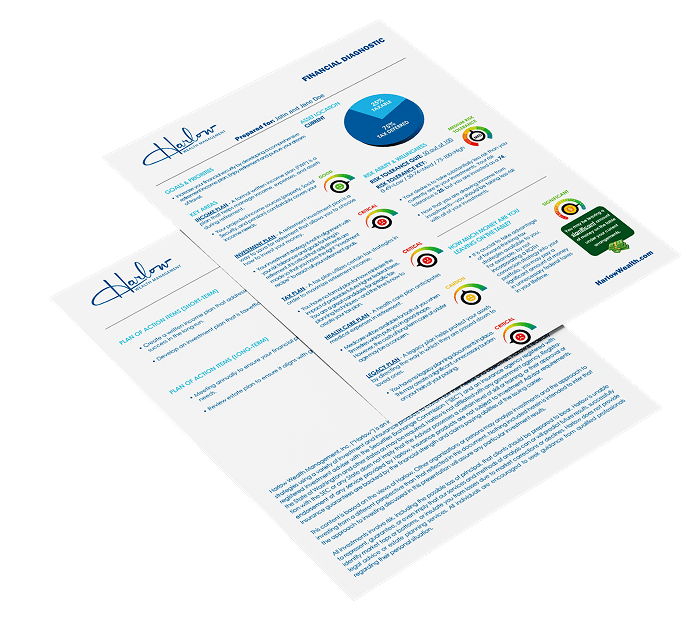
Is Your Retirement Income Built to Last?
Discover potential income gaps, optimize your withdrawal strategy and ensure your money lasts as long as you do.
Claim your complimentary Financial Diagnostic exclusively from Harlow Wealth Management.
Is Your Retirement Income Built to Last?
Discover potential income gaps, optimize your withdrawal strategy and ensure your money lasts as long as you do.
Claim your FREE Financial Diagnostic exclusively from Harlow Wealth Management.