

Could Your Retirement Income Increase Your Medicare Premiums? A Portland–Vancouver Planning Guide
Could Your Retirement Income Increase Your Medicare Premiums? A Portland–Vancouver Planning Guide

You have saved for retirement, built an investment portfolio and started thinking about how to turn those savings into income. Then a Medicare notice arrives with a premium higher than you expected.
For households in Portland, Oregon, and Vancouver, Washington, that increase can be connected to a decision made two years earlier: a retirement account withdrawal, a Roth conversion or an investment sale.
The connection is called the income-related monthly adjustment amount, or IRMAA. Understanding it can help you evaluate retirement decisions with a clearer picture of their full cost.
Figures checked October 29, 2026. This article uses finalized 2026 Medicare premiums and income thresholds. Future-year amounts may differ.
Why some retirees pay more for Medicare
Medicare Part B covers services such as doctor visits and outpatient care. In 2026, its standard monthly premium is $202.90, up from $185 in 2025—an increase of approximately 9.7%. That equals $2,434.80 annually per person, before other health care expenses.¹
Higher-income beneficiaries can owe an additional amount for Part B and, if enrolled in Medicare prescription drug coverage, Part D. These adjustments apply to roughly 8% of beneficiaries in each program.¹ CMS
IRMAA is based on income reported for federal tax purposes. It is separate from a late-enrollment penalty and does not mean you selected a more expensive insurance plan.²
For a retired couple, the household effect matters: when both spouses have Part B and Part D coverage, each can owe the applicable adjustment.
What are the 2026 Medicare income thresholds?
For 2026, the first surcharge begins when modified adjusted gross income exceeds $109,000 for an individual filer or $218,000 for married couples filing jointly.²
|
Individual filing: annual MAGI |
Married filing jointly: annual MAGI |
Monthly Part B premium, per person |
Monthly Part D surcharge, per person |
|
$109,000 or less |
$218,000 or less |
$202.90 |
$0 |
|
Above $109,000 through $137,000 |
Above $218,000 through $274,000 |
$284.10 |
$14.50 |
|
Above $137,000 through $171,000 |
Above $274,000 through $342,000 |
$405.80 |
$37.50 |
|
Above $171,000 through $205,000 |
Above $342,000 through $410,000 |
$527.50 |
$60.40 |
|
Above $205,000 but below $500,000 |
Above $410,000 but below $750,000 |
$649.20 |
$83.30 |
|
$500,000 or more |
$750,000 or more |
$689.90 |
$91.00 |
Source: Social Security Administration and CMS. Part B figures include the standard premium; Part D figures are added to the prescription drug plan premium. Special thresholds apply to married people filing separately who lived together during the tax year.¹˒² SSA
These brackets create a planning issue: crossing a threshold by a small amount can trigger the full adjustment for that tier.
Medicare generally looks back two years
For Medicare purposes, modified adjusted gross income generally equals adjusted gross income plus tax-exempt interest. Social Security generally uses tax information from two years before the premium year.³
That means:
- 2024 income generally determines 2026 premiums.
- 2025 income generally determines 2027 premiums.
- 2026 income generally determines 2028 premiums.
A withdrawal made this December may therefore affect a Medicare bill well after the money has been spent.
This also makes the years approaching age 65 important. Income generated around age 63 can affect premiums when Medicare begins, depending on the calendar years involved.
The 2026 thresholds are not a guaranteed ceiling for a conversion made in 2026. That conversion generally affects 2028 premiums, using the thresholds applicable in 2028.³ 12/02/2025
Which retirement decisions can affect the calculation?
Several familiar income sources can feed into federal adjusted gross income and therefore the Medicare calculation.
Traditional retirement account withdrawals. The taxable portion of an IRA distribution increases income. Required minimum distributions can also increase income even when you do not need the money for spending.⁴
Roth conversions. The taxable portion of a conversion adds income in the conversion year. Qualified Roth IRA distributions, by contrast, are excluded from gross income.⁴ Internal Revenue Service
Social Security benefits. The portion included in federal taxable income flows into adjusted gross income. The calculation does not simply count your entire benefit as taxable income.⁵ Internal Revenue Service
Investment income. Realized taxable capital gains, dividends and interest can increase adjusted gross income. Tax-exempt interest is added back specifically for Medicare MAGI.³
The distinction matters: money available to spend and income counted by Medicare are different measures. A retirement plan should track both.
A hypothetical couple facing a higher bill
Consider a married Vancouver couple whose 2024 Medicare MAGI was $210,000 before a fully taxable $25,000 Roth conversion. Assume the conversion brought their final MAGI to $235,000 and both spouses have Part B and Part D throughout 2026.
Under the 2026 schedule, each spouse would owe an additional:
- $81.20 monthly for Part B
- $14.50 monthly for Part D
The combined increase would be $191.40 per month, or $2,296.80 for the year, above their standard Part B and existing drug-plan premiums. These amounts are calculated from the published schedule.¹˒² CMS
This simplified illustration assumes no other income changes and excludes conversion taxes, other insurance costs and individual exceptions.
The conversion might still support their long-term plan. But the Medicare increase belongs in the comparison alongside its tax cost and potential future benefits.
Does living in Portland or Vancouver change IRMAA?
The federal income thresholds are the same on both sides of the Columbia River. A move from Portland to Vancouver does not, by itself, remove a Medicare income surcharge.²˒³
State tax treatment still deserves separate attention. Oregon does not tax Social Security benefits, although it generally taxes pension income received by residents, subject to applicable exceptions.⁶ The federally taxable portion of Social Security can nevertheless affect Medicare MAGI.³˒⁵ oregon.gov
For a Portland household considering a Roth conversion or a move, this means looking at several connected questions: What income will appear on the federal return? What state taxes apply? Which year will Medicare review? How does the transaction affect future withdrawals?
A change of address alone does not answer those questions.
Ways to plan before creating additional income
Compare withdrawal sources. Before funding a major purchase from an IRA, compare available cash, taxable investments and qualified Roth withdrawals. Consider investment consequences as well as the income each option creates.
Evaluate conversions over multiple years. A series of smaller conversions may produce a different result from one large conversion. Model taxes and projected Medicare costs together rather than focusing on a tax bracket alone.
Review charitable giving from an IRA. Beginning at age 70½, eligible IRA owners can make qualified charitable distributions directly to eligible charities. When requirements are met, the amount is excluded from income and can count toward an applicable required minimum distribution. Annual limits and other restrictions apply.⁴ Internal Revenue Service
Leave room for income you do not fully control. Interest, dividends and year-end fund distributions can change a projection. A plan that lands exactly on an estimated threshold has little room for surprises.
These are planning considerations, not reasons to avoid every surcharge. The useful comparison is the transaction’s overall effect across retirement.
What if your income fell after you retired?
A Medicare determination may reflect working-year income even though your current income is lower.
Social Security allows requests for a new determination after qualifying life-changing events, including stopping work, reducing work hours, divorce or the death of a spouse. Form SSA-44 is used to report qualifying events and the associated income reduction. Supporting documentation is required.⁷ SSA
However, a one-time income increase does not automatically qualify for relief. Social Security specifically lists IRA conversions and capital gains from property sales among nonqualifying one-time events.⁸ 06/18/2013
Review the notice carefully. Retirement-related relief and disagreement with an incorrect income record involve different circumstances.
Bring Medicare into the retirement income conversation
A portfolio balance cannot tell you everything about the income it will provide. The timing and source of withdrawals can affect taxes, Medicare premiums and the amount available for everyday life.
For Portland and Vancouver households, those connections are a useful reason to review income, investments, taxes and health care together.
The Harlow Financial Diagnostic provides an opportunity to review how those parts of your retirement picture fit together. Before making a significant withdrawal or conversion, consider whether your plan accounts for both the immediate cost and the potential effect on future Medicare premiums.
This article is for educational purposes and is not individualized tax, investment or Medicare enrollment advice. Consult qualified professionals about your circumstances. Harlow Wealth Management is not affiliated with Medicare or any government agency.
References
-
- Centers for Medicare & Medicaid Services. (2025, November 14). 2026 Medicare Parts A & B premiums and deductibles. https://www.cms.gov/newsroom/fact-sheets/2026-medicare-parts-b-premiums-deductibles
- Social Security Administration. (n.d.). Premiums: Rules for higher-income beneficiaries. Retrieved October 29, 2026, from https://www.ssa.gov/benefits/medicare/medicare-premiums.html
- Social Security Administration. (2025, December 2). HI 01101.010 modified adjusted gross income (MAGI). Program Operations Manual System. https://secure.ssa.gov/poms.nsf/lnx/0601101010
- Internal Revenue Service. (n.d.). Publication 590-B (2025), distributions from individual retirement arrangements (IRAs). Retrieved October 29, 2026, from https://www.irs.gov/publications/p590b
- Internal Revenue Service. (n.d.). Social Security income. Retrieved October 29, 2026, from https://www.irs.gov/faqs/social-security-income
- Oregon Department of Revenue. (n.d.). Personal income tax. Retrieved October 29, 2026, from https://www.oregon.gov/dor/programs/individuals/Pages/PIT.aspx
- Social Security Administration. (n.d.). Request to lower an income-related monthly adjustment amount (IRMAA). Retrieved October 29, 2026, from https://www.ssa.gov/medicare/lower-irmaa
- Social Security Administration. (2013, June 18). HI 01120.005 life changing events. Program Operations Manual System. https://secure.ssa.gov/poms.nsf/lnx/0601120005
This article is for general educational purposes only and should not be considered individualized investment, tax, legal, or insurance advice. Tax laws, property expenses, and healthcare coverage may change. Consult qualified professionals regarding your specific circumstances.
Past performance is not indicative of future results. The material above has been provided for informational purposes only and is not intended as legal, tax, or investment advice or a recommendation of any particular security or strategy. The investment strategy and themes discussed herein may be unsuitable for investors depending on their specific investment objectives and financial situation. Information obtained from third-party sources is believed to be reliable though its accuracy is not guaranteed, and Harlow Wealth Management, Inc. (“Harlow”) makes no representation or warranty as to the accuracy or completeness of the information, which should not be used as the basis of any investment decision. Information contained on third party websites that Harlow may link to is not reviewed in their entirety for accuracy, and Harlow assumes no liability for the information contained on these websites. Opinions expressed in this commentary reflect subjective judgments of the author based on conditions at the time of writing and are subject to change without notice. No part of this material may be reproduced in any form, or referred to in any other publication, without express written permission from Harlow. For more information about Harlow, including our Form ADV brochures, please visit https://adviserinfo.sec.gov and search our firm name.
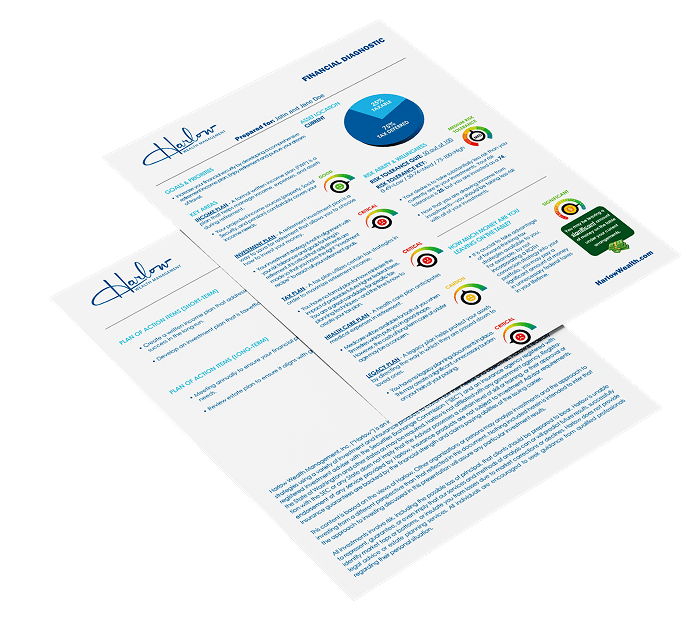
Is Your Retirement Income Built to Last?
Discover potential income gaps, optimize your withdrawal strategy and ensure your money lasts as long as you do.
Claim your complimentary Financial Diagnostic exclusively from Harlow Wealth Management.
Is Your Retirement Income Built to Last?
Discover potential income gaps, optimize your withdrawal strategy and ensure your money lasts as long as you do.
Claim your FREE Financial Diagnostic exclusively from Harlow Wealth Management.