

How to Switch Financial Advisors in Vancouver, WA: What Happens to Your Accounts?
How to Switch Financial Advisors in Vancouver, WA: What Happens to Your Accounts?

If you’re thinking about switching financial advisors, one of the first questions is what will happen to the money you’ve already invested. Will you have to sell anything? Could the move create a tax bill? Will your monthly retirement income arrive on time?
The first step is to find out whether your accounts need to move to a different custodian, the financial institution that holds them. If the new advisor can work with your current custodian, ask whether you can keep your accounts there and change who has authority to manage them. If you’ll need a new custodian, ask for an account-by-account transfer plan before you sign.
Will I have to sell my investments?
Many investments can move in kind, meaning the shares themselves transfer to the receiving account. Whether a holding can move depends on the investment and whether the receiving firm can hold it. Some proprietary funds and other investments may need special handling. Ask the new firm to flag any holdings it can’t accept and explain your options, including whether you can leave them where they are.¹
For example, say you bought shares in a taxable brokerage account for $20,000 and they’re now worth $35,000. If the shares transfer in kind and ownership stays the same, the move itself generally doesn’t realize the gain. If you sell those shares for $35,000 and your adjusted cost basis is $20,000, you generally realize a $15,000 capital gain. The same issue can come up if the new advisor sells the shares after they arrive, so ask what they expect to keep and what they may recommend changing.¹˒²
What happens to my IRA or 401(k)?
A traditional IRA can generally move directly from one custodian to another as a trustee-to-trustee transfer. The money goes straight to the receiving institution, so you generally avoid a taxable distribution. If you’re considering moving pre-tax money into a Roth IRA, ask about the tax impact of a conversion before authorizing it.³
A 401(k) through a current or former employer is a separate decision. If you’re eligible to move it, compare staying in the plan with a rollover, looking at fees, investment options and withdrawal rules. If an employer-plan distribution is paid to you personally, withholding and a 60-day rollover deadline can apply. If a rollover fits your plan, ask the plan administrator how to arrange a direct rollover.³
Who handles the move, and how long does it take?
When accounts need to move, the receiving firm typically starts the transfer after you authorize it. Many brokerage transfers go through the Automated Customer Account Transfer Service (ACATS). The timing depends on the accounts and holdings involved. Ask the receiving firm for an estimate, whether trading could be restricted during the move and how it will handle any assets that need separate paperwork.¹
If you rely on a monthly withdrawal to pay bills, ask who will handle your next scheduled payment before you start. Confirm when to set up bank instructions at the new custodian. Once the transfer is complete, compare your last statement from the old firm with your first statement from the new one. Check that holdings, cash and any available cost-basis records match what you expected, then verify beneficiaries and recurring instructions with the receiving firm.¹
What should I ask a new advisor before I switch?
- What can I keep? Ask which accounts and investments can stay where they are or move in kind.
- What would you recommend selling, and why? Ask about the potential tax impact before making changes in a taxable account.
- What will this cost? Ask about transfer or closing fees, any contract surrender charges, and what you’d pay for ongoing advice and investments.¹
- Who will handle the details? Confirm who will coordinate the transfer and check that scheduled payments and tax withholding are set up the way you intend.
A recent statement for each account gives a prospective advisor a starting point for this conversation. Ask them to walk you through what they’d keep, what they’d change and how those decisions fit the retirement income you need.
Get a second opinion before you decide
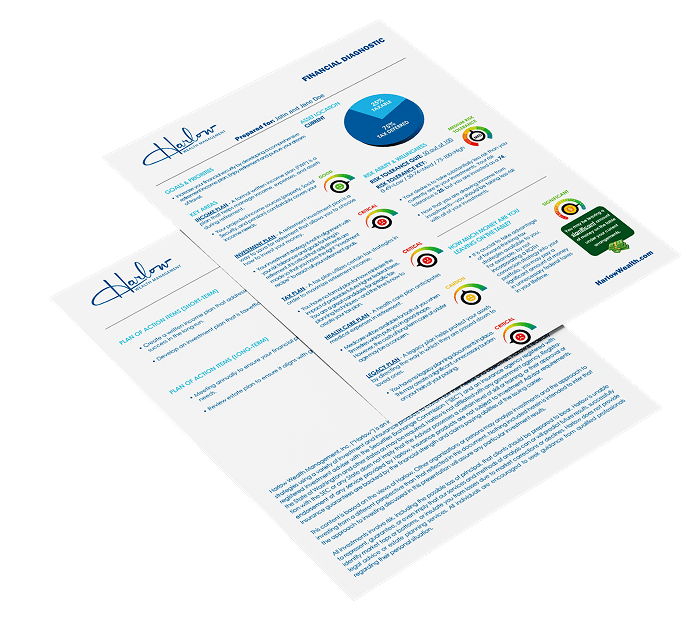
If you’re retired or nearing retirement in Vancouver, WA, or the Portland metro area, Harlow Wealth Management’s Complimentary Financial Diagnostic can help you see how your investments, retirement income and taxes work together. It’s designed for households with portfolios of $400,000 or more. You’ll meet with an advisor to discuss your situation, then review the findings together and receive a written report.⁴
References
¹ U.S. Securities and Exchange Commission. (n.d.). Transferring your brokerage account. Investor.gov. https://www.investor.gov/introduction-investing/investing-basics/glossary/transferring-your-brokerage-account
² Internal Revenue Service. (n.d.). Topic no. 409, capital gains and losses. https://www.irs.gov/taxtopics/tc409
³ Internal Revenue Service. (n.d.). Rollovers of retirement plan and IRA distributions. https://www.irs.gov/retirement-plans/plan-participant-employee/rollovers-of-retirement-plan-and-ira-distributions
⁴ Harlow Wealth Management. (n.d.). Financial diagnostic report. https://harlowwealth.com/diagnostic-report/
This article provides general wellness information and is not medical advice. Consult your health care professional about your individual needs.
Past performance is not indicative of future results. The material above has been provided for informational purposes only and is not intended as legal, tax, or investment advice or a recommendation of any particular security or strategy. The investment strategy and themes discussed herein may be unsuitable for investors depending on their specific investment objectives and financial situation. Information obtained from third-party sources is believed to be reliable though its accuracy is not guaranteed, and Harlow Wealth Management, Inc. (“Harlow”) makes no representation or warranty as to the accuracy or completeness of the information, which should not be used as the basis of any investment decision. Information contained on third party websites that Harlow may link to is not reviewed in their entirety for accuracy, and Harlow assumes no liability for the information contained on these websites. Opinions expressed in this commentary reflect subjective judgments of the author based on conditions at the time of writing and are subject to change without notice. No part of this material may be reproduced in any form, or referred to in any other publication, without express written permission from Harlow. For more information about Harlow, including our Form ADV brochures, please visit https://adviserinfo.sec.gov and search our firm name.
Is Your Retirement Income Built to Last?
Discover potential income gaps, optimize your withdrawal strategy and ensure your money lasts as long as you do.
Claim your complimentary Financial Diagnostic exclusively from Harlow Wealth Management.
Is Your Retirement Income Built to Last?
Discover potential income gaps, optimize your withdrawal strategy and ensure your money lasts as long as you do.
Claim your FREE Financial Diagnostic exclusively from Harlow Wealth Management.