

The Best Age to Retire When You Live in Portland or Vancouver
The Best Age to Retire When You Live in Portland or Vancouver

Is 62 the right age to retire? What about 65, 67, or even 70?
For people living in the Portland-Vancouver metro area, the answer depends on much more than a birthday. Housing costs, health insurance, Social Security, taxes, and which side of the Columbia River you call home can all influence when retirement becomes financially sustainable.
For many Pacific Northwest households, the strongest retirement window falls between ages 65 and 67. Age 65 generally provides access to Medicare, while age 67 is the Social Security full retirement age for anyone born in 1960 or later.¹ ² However, that does not mean everyone should retire within that range.
The best age to retire is the point at which your income, investments, taxes, health care, and lifestyle can work together without placing unnecessary pressure on your future.
Why Retiring at 62 Can Be Tempting
Age 62 is the earliest most people can begin receiving Social Security retirement benefits.¹ After decades of commuting through Portland traffic, crossing the Interstate Bridge, or working for one of the region’s major health systems, manufacturers, government agencies, or technology employers, retiring as soon as possible can sound appealing.
The tradeoff is that starting Social Security at 62 can permanently reduce your monthly benefit. For someone born in 1960 or later, claiming at 62 instead of the full retirement age of 67 can reduce the worker’s benefit by approximately 30%.¹
A benefit of $3,000 per month at age 67, for example, could be reduced to approximately $2,100 per month when claimed at 62. That $900 monthly difference could become increasingly important later in retirement as health care, housing, and other expenses rise.
Retiring at 62 may still make sense when:
- You have substantial savings outside of Social Security.
- Your pension or other guaranteed income can cover essential expenses.
- Health concerns make continuing to work difficult.
- Your job is eliminated or retirement arrives unexpectedly.
- You have an affordable source of health insurance before Medicare.
- Retiring early allows a higher-earning spouse to continue working and delay Social Security.
The important distinction is that retiring from work and claiming Social Security do not have to happen at the same time. Someone may retire at 62, use investments or other income for several years, and delay Social Security to create a larger future benefit.
Age 65 Solves One of the Biggest Retirement Questions
For many Portland and Vancouver residents, age 65 represents the first practical retirement milestone because it is when Medicare eligibility generally begins.²
Before 65, someone leaving an employer-sponsored health plan may need to use COBRA, a spouse’s plan, private insurance, or coverage purchased through the Oregon Health Insurance Marketplace or Washington Healthplanfinder.
That bridge can be expensive. It can also make early retirement costs unpredictable, particularly for a couple in which one spouse becomes eligible for Medicare several years before the other.
At 65, Medicare can make health care expenses easier to estimate, but it does not make health care free. Retirees may still be responsible for:
- Medicare Part B and Part D premiums
- Medicare Advantage or Medigap premiums
- Deductibles and copayments
- Dental, vision, and hearing expenses
- Long-term care costs
- Income-related Medicare surcharges
Retiring at 65 may be attractive if your investments can support your lifestyle and delaying Social Security remains part of the strategy. It can provide the freedom to leave work without automatically locking in a reduced Social Security benefit.
Why Age 67 Is a Strong Target for Many Local Retirees
For people born in 1960 or later, age 67 is the Social Security full retirement age.¹ By this point, Medicare eligibility has already begun, Social Security is no longer reduced for claiming early, and retirement accounts have had two additional years to potentially grow compared with retiring at 65.
Age 67 may be especially compelling for households carrying a mortgage or other major housing expense.
According to the U.S. Census Bureau, the median value of an owner-occupied home in Portland was approximately $581,500 during the 2020–2024 measurement period. In Vancouver, the corresponding median was approximately $462,400.³ ⁴ Vancouver homeowners with a mortgage faced median monthly owner costs of approximately $2,035.⁴
Those numbers matter because housing is often one of the largest differences between retiring comfortably and placing too much pressure on a portfolio.
Working until 67 may provide time to:
- Pay down or eliminate a mortgage.
- Build additional cash reserves.
- Make catch-up contributions to retirement accounts.
- Reduce higher-interest debt.
- Complete major home repairs before leaving work.
- Increase future Social Security income.
- Create a clearer plan for living on retirement cash flow.
For many Portland-Vancouver households, 67 is not necessarily the earliest possible retirement age. It may simply provide a stronger margin for error.
The Case for Waiting Until 70
Social Security benefits continue to increase when they are delayed beyond full retirement age, up to age 70. For people born in 1943 or later, delayed retirement credits generally increase the benefit by 8% per year after full retirement age.⁵
Someone whose full retirement benefit is $3,000 per month at 67 could receive approximately $3,720 per month at 70 before future cost-of-living adjustments. That larger benefit continues for life and may also strengthen the survivor benefit available to a spouse.
Waiting until 70 can be especially valuable when:
- You are healthy and longevity runs in your family.
- You enjoy working or want to transition gradually.
- Your spouse may eventually depend on your survivor benefit.
- You have sufficient investments to delay Social Security.
- You want a larger source of inflation-adjusted lifetime income.
- You are the higher earner in a married household.
Longevity deserves serious consideration. Nationally, a person reaching age 65 in 2022 could expect to live an average of another 18.9 years. For women, the average was 20.2 additional years.⁶ Washington’s overall life expectancy was approximately 80 years in the CDC’s 2018–2022 estimates.⁷
A healthy 65-year-old in Portland or Vancouver should therefore consider the possibility of funding 25 to 30 years of retirement, not merely planning to the average.
Portland and Vancouver Do Not Have the Same Tax Picture
One of the most important local considerations is that Oregon and Washington treat income differently.
Oregon has a personal income tax. Although Oregon generally does not tax Social Security benefits, withdrawals from traditional IRAs, 401(k)s, and many pensions may be subject to Oregon income tax.⁸
Washington does not impose a broad individual income tax on wages, Social Security, pensions, or distributions from retirement accounts. It does, however, impose a tax on certain long-term capital gains above an inflation-adjusted exemption, while qualifying retirement accounts and real estate are generally excluded.⁹
This does not automatically mean every retiree should move to Vancouver. Oregon has no general sales tax, while Washington relies more heavily on sales and other taxes. Property taxes, estate planning, housing expenses, health care access, and proximity to family can be equally important.
The larger point is that a Portland resident and a Vancouver resident with identical assets and identical spending may have different after-tax retirement outcomes.
Crossing the Columbia River can change the tax calculation, but it should not be evaluated in isolation.
The Best Age May Depend on Your Housing Plan
Housing equity is a meaningful asset for many longtime Portland and Vancouver homeowners. However, a home’s value does not automatically produce retirement income.
Before choosing a retirement age, consider whether you plan to:
- Remain in your current home.
- Pay off the mortgage before retiring.
- Downsize within the Portland-Vancouver area.
- Move from Portland to Vancouver or the reverse.
- Relocate to a lower-cost community.
- Use home equity later in retirement.
- Budget for maintenance, accessibility improvements, and property taxes.
A household with a paid-off home may be ready to retire years earlier than a household with the same investments and a $2,500 monthly mortgage. Conversely, selling an expensive home does not always create as much flexibility as expected if the replacement home is also located in a high-cost Pacific Northwest market.
Use a Retirement Range Instead of One Magic Age
A better way to plan is to evaluate several possible retirement dates.
Retiring at 62
This may provide more healthy years away from work, but it requires a five-year health insurance bridge to Medicare and can result in permanently reduced Social Security benefits.
Retiring at 65
Medicare eligibility removes a major obstacle, but claiming Social Security at 65 can still reduce benefits for someone whose full retirement age is 67.
Retiring at 67
This provides full Social Security retirement benefits for people born in 1960 or later and allows additional time to save, reduce debt, and prepare for retirement expenses.
Retiring at 70
This can maximize Social Security and provide additional working years, but it may not be the right choice for someone with health concerns, caregiving responsibilities, or a strong desire to spend more active years outside the workforce.
The strongest plan may combine these ages. You could retire at 65, use retirement savings strategically, and delay Social Security until 67 or 70. One spouse could retire while the other continues working. You could also move into part-time or consulting work before retiring completely.
Five Questions to Answer Before Choosing Your Retirement Age
1. How much will retirement actually cost?
Build a realistic budget that includes travel, home maintenance, health care, taxes, charitable giving, and financial support for family members. Retirement spending is rarely limited to basic monthly bills.
2. Where will your income come from?
Identify how much will come from Social Security, pensions, investments, rental income, annuities, or part-time work. Then determine which income sources are guaranteed and which depend on market performance.
3. How will you pay for health care?
If you plan to retire before 65, price the entire Medicare gap. If you are already Medicare-eligible, include premiums, supplemental coverage, prescriptions, dental care, and possible income-related surcharges.
4. How will taxes affect withdrawals?
The order in which you use taxable accounts, traditional retirement accounts, and Roth accounts can change your lifetime tax bill. This is especially important for Oregon residents and for households considering a move across the state line.
5. What happens if retirement lasts longer than expected?
A plan that works until age 82 may not be sufficient if you or your spouse lives into your 90s. Test the plan against a longer life, difficult markets, inflation, and future care expenses.
So, What Is the Best Age to Retire in Portland or Vancouver?
For many local households, ages 65 to 67 provide the strongest balance between Medicare eligibility, Social Security benefits, additional savings, and time away from work.
But the best age is not determined by Medicare or Social Security alone. It is the age when your financial resources can reliably support the life you want without depending on everything going perfectly.
That could be 62 for someone with a pension, substantial savings, and affordable health coverage. It could be 65 for someone ready to leave work but willing to delay Social Security. It could be 67 or 70 for someone focused on maximizing lifetime income and providing greater protection for a spouse.
The calendar gives everyone the same retirement milestones. Your financial plan determines which of them should matter to you.
At Harlow Wealth Management, our Financial Diagnostic examines income, investments, taxes, health care, and legacy planning together. If you are approaching retirement in Portland, Vancouver, or elsewhere in the Pacific Northwest, a personalized analysis can help show whether your preferred retirement date is financially sustainable—and what may need to change to make it possible.
This article is intended for educational purposes only and should not be considered individualized investment, tax, legal, or Medicare advice.
References
-
-
- Social Security Administration. (n.d.). Starting your retirement benefits early. https://www.ssa.gov/benefits/retirement/planner/agereduction.html
- Centers for Medicare & Medicaid Services. (n.d.). Get started with Medicare. Medicare.gov. https://www.medicare.gov/basics/get-started-with-medicare
- U.S. Census Bureau. (2026). QuickFacts: Portland city, Oregon. https://www.census.gov/quickfacts/fact/table/portlandcityoregon/IPE120225
- U.S. Census Bureau. (2026). QuickFacts: Vancouver city, Washington. https://www.census.gov/quickfacts/fact/table/vancouvercitywashington/PST120225
- Social Security Administration. (n.d.). Delayed retirement credits. https://www.ssa.gov/benefits/retirement/planner/delayret.html
- Xu, J., Murphy, S. L., Kochanek, K. D., & Arias, E. (2024). Mortality in the United States, 2022. NCHS Data Brief, 492. Centers for Disease Control and Prevention. https://www.cdc.gov/nchs/products/databriefs/db492.htm
- National Center for Health Statistics. (2025). U.S. life expectancy by state and sex, 2018–2022. Centers for Disease Control and Prevention. https://www.cdc.gov/nchs/data-visualization/state-life-expectancy/2022.htm
- Oregon Department of Revenue. (n.d.). Personal income tax information. https://www.oregon.gov/dor/programs/individuals/Pages/default.aspx
- Washington State Department of Revenue. (n.d.). Capital gains tax. https://dor.wa.gov/taxes-rates/other-taxes/capital-gains-tax
-
Past performance is not indicative of future results. The material above has been provided for informational purposes only and is not intended as legal, tax, or investment advice or a recommendation of any particular security or strategy. The investment strategy and themes discussed herein may be unsuitable for investors depending on their specific investment objectives and financial situation. Information obtained from third-party sources is believed to be reliable though its accuracy is not guaranteed, and Harlow Wealth Management, Inc. (“Harlow”) makes no representation or warranty as to the accuracy or completeness of the information, which should not be used as the basis of any investment decision. Information contained on third party websites that Harlow may link to is not reviewed in their entirety for accuracy, and Harlow assumes no liability for the information contained on these websites. Opinions expressed in this commentary reflect subjective judgments of the author based on conditions at the time of writing and are subject to change without notice. No part of this material may be reproduced in any form, or referred to in any other publication, without express written permission from Harlow. For more information about Harlow, including our Form ADV brochures, please visit https://adviserinfo.sec.gov and search our firm name.
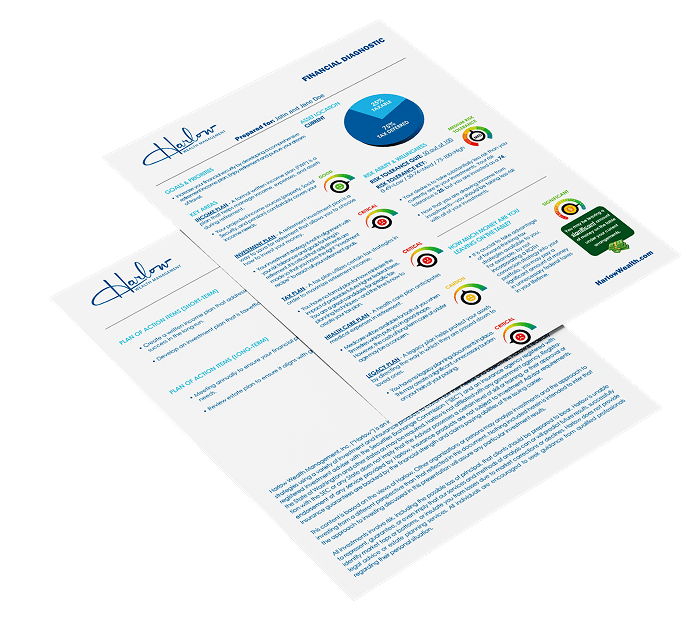
Is Your Retirement Income Built to Last?
Discover potential income gaps, optimize your withdrawal strategy and ensure your money lasts as long as you do.
Claim your complimentary Financial Diagnostic exclusively from Harlow Wealth Management.
Is Your Retirement Income Built to Last?
Discover potential income gaps, optimize your withdrawal strategy and ensure your money lasts as long as you do.
Claim your FREE Financial Diagnostic exclusively from Harlow Wealth Management.